May 06, 2026
•
8 min read


And that's just the beginning of why this question — "what song has the most views on YouTube?" — is way messier than it looks.
The answer depends on whether you count kids' content as "music," whether you trust the numbers YouTube shows you, and whether you care about how the algorithm manufactured the whole thing in the first place.
The answer depends on how broadly you define a “song” on YouTube.
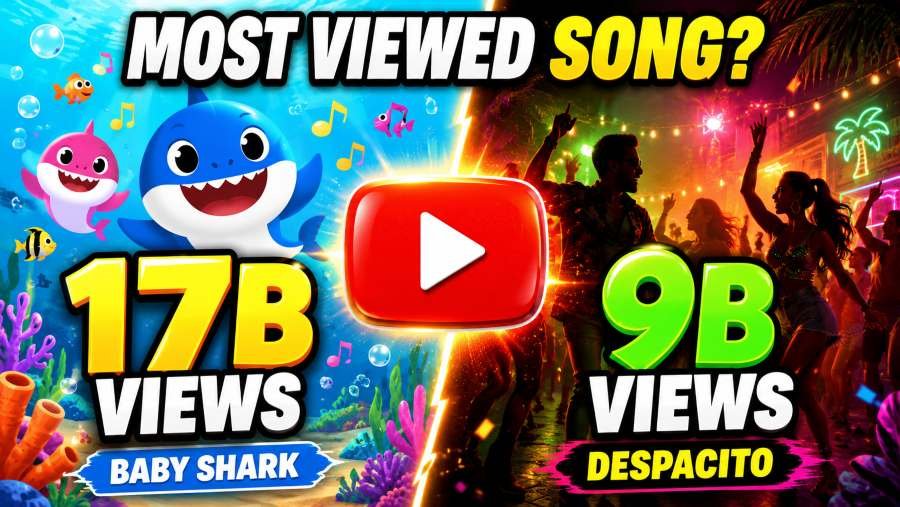
If every musical video on YouTube is included, the clear winner is Baby Shark Dance by Pinkfong, with roughly 16.9 billion views as of mid-2026.
Released in 2016, the two-minute children’s song became an extraordinary global phenomenon and eventually grew into the most-viewed piece of content in YouTube’s history. Its view count is approaching 17 billion, which is equivalent to nearly every person on Earth watching it twice.
By the broadest possible definition, Baby Shark Dance is the most-viewed song on YouTube.
However, if the question is focused on mainstream music videos — songs people typically choose to stream as popular music — the answer changes.
In that category, the most-viewed song is Despacito by Luis Fonsi featuring Daddy Yankee, with around 9 billion views. This refers to the original Spanish-language version, not the Justin Bieber remix, which helped expand the song’s global reach but is not the main source of its YouTube dominance.
The gap between Despacito and the next closest mainstream music video is significant. Wiz Khalifa’s See You Again, featuring Charlie Puth, has around 6.9 billion views, placing it well behind Despacito.
In other words, among mainstream music videos, Despacito is not merely leading — it is far ahead of the competition.
This distinction is important because many rankings treat children’s content and mainstream music as if they operate in the same way. Technically, Baby Shark Dance deserves the top position. It is a song, and its view count is unmatched.
But children’s videos behave differently on YouTube. They are often played repeatedly, sometimes in long viewing sessions, because young children tend to request the same content again and again. Mainstream music videos, by contrast, rely more heavily on voluntary replay, fan engagement, cultural impact, and repeat listening by older audiences.
Comparing the two without acknowledging that difference can be misleading. Baby Shark Dance is the overall leader, but Despacito remains the most-viewed mainstream music video on YouTube.
The gap between #1 and #10 is nearly 4 billion views. And the list is stranger than you'd expect — reggaeton, memes, a World Cup anthem, and a wedding-crashing stunt all share the same leaderboard.
Luis Fonsi and Daddy Yankee dropped this Puerto Rican reggaeton track in January 2017. It stole the crown that August. Nine years later, it's still untouchable.
Wiz Khalifa and Charlie Puth built this as a tribute to Paul Walker. It held #1 for roughly 24 days before Despacito bulldozed past.
Ed Sheeran's Shape of You sits at about 6.65 billion views. One of three Sheeran tracks in the top 100. Consistency beats one-hit virality.
PSY's horse-dance anthem owned the top spot for nearly five years. First to break 1 billion, then 2 billion, up to 2.8 billion before anyone else got close.
The spread is wild. Bruno Mars doing retro funk, a 2005 meme character on a moped, a green alien, Shakira's World Cup anthem, a OneRepublic sleeper, and Maroon 5 crashing weddings. No single formula.
Crazy Frog at 5.7 billion? Dame Tu Cosita at 5.3 billion? These aren't "good" songs in any traditional sense. They're meme vehicles. People share them to ambush friends. That's the engine.
YouTube's most-viewed crown has changed hands eight times since 2005. Each holder broke a barrier the previous one couldn't imagine — from 100 million to 17 billion, the scale got absurd fast.
Cansei de Ser Sexy's "Music Is My Hot Hot Sex" was the first proper song to top YouTube. Then Avril Lavigne's "Girlfriend" took over with less than 100 million views. The numbers were tiny by today's standards.
Lady Gaga's "Bad Romance" broke 200 million in 5.5 months. Then Justin Bieber's "Baby" held the top for over two years and was the first to cross every threshold from 250M to 800M.
PSY hit 1 billion on December 21, 2012. First ever. Then he just kept going — 2B, 3B, all the way to 2.8B before anyone else got close. Nearly 5 years at #1.
Hit 3 billion on August 4, 2017. Then 4B, 5B, 6B, 7B, 8B, 9B. The Bieber remix helped, but the original Spanish version did the heavy lifting. A Puerto Rican track ruling the world.
Topped the list in November 2020. Passed 10 billion in January 2022. Now at nearly 17 billion. It's been #1 for over 1,800 days — longer than any previous holder. And it's not going anywhere.
The numbers look solid. They're not. YouTube's view count is a moving target — filtered, capped, audited, and delayed. Here's what actually happens behind the counter.
Standard videos need 30 seconds of watch time to register. But here's the catch — that rule doesn't apply evenly. Kids videos get replayed in full. Adult music videos get skipped after the hook.
YouTube caps repeat views from the same user at 4-5 per 24-hour window. But that cap resets daily. A parent playing Baby Shark for their toddler every day for a year? That's 1,460+ countable views from one household.
BTS's "ON" dropped from 83 million to 48 million after YouTube's audit. The platform aggressively filters bots. Most articles cite view counts like they're carved in stone. They're not — they're alive, and they get audited.
Since March 2025, every Shorts play counts — no 30-second minimum. This fundamentally changes the game. Short-form views inflate faster but mean less per view. The leaderboard might look different in two years.
Creators see one number in Studio. The public sees another. YouTube delays public updates, freezes counts during audits, and rounds differently. The number you see isn't "live" — it's curated.
Nobody calls Baby Shark their favorite song. Nobody puts it on at a party. Yet it's sitting at nearly 17 billion views — double Despacito's count — and the gap keeps widening. Here's how that happened.
A 2-minute song designed for toddlers is going to get replayed 10 times in a row. That's not fandom — that's parenting survival. The repeat mechanics of children's content break every comparison metric.
The people who complain about Baby Shark the loudest are the same people keeping it at #1. A crying toddler doesn't care about your Spotify playlist.
Pinkfong didn't just get a hit — they built an empire. Merch, TV shows, live tours, a Netflix deal. The video isn't the product; it's the funnel. 17 billion views is marketing, not just music.
Baby Shark has nearly double Despacito's views. The gap widens daily. Unless YouTube changes how kids' content counts, nothing is catching it. The record might be permanent.
Nobody asked for Despacito nine billion times. The algorithm did much of the work. Once a video reaches a certain level of momentum, YouTube begins treating it as authoritative and starts placing it in autoplay queues, suggested videos, and homepage recommendations. That is how a popular song becomes part of the platform’s machinery.
Autoplay and suggested videos are two of the biggest hidden forces behind massive YouTube view counts.
After Despacito gained enough early velocity, YouTube began placing it after related music content. For years, it functioned like one of the platform’s default next videos. That kind of visibility is not purely organic. It is infrastructure.
The song’s success was not built only by people searching for it directly. It was also built by YouTube repeatedly putting it in front of viewers who were already watching similar content.
Spanish-language music dominates YouTube in a way it does not always dominate Spotify.
Look at the top YouTube music rankings and Spanish-language tracks appear everywhere. On Spotify, however, the leaderboard often looks different. The reason is simple: in many regions, especially Latin America and Southeast Asia, YouTube is not just a video platform. It is the main music platform.
For millions of listeners, YouTube is where music discovery, replay, sharing, and daily listening all happen.
In many developing markets, YouTube functions like the world’s free radio.
Listeners do not need a Spotify subscription, an Apple Music account, or even a dedicated music app. YouTube is free, widely available, and works on almost any phone. In markets where paid streaming is a luxury, that accessibility matters enormously.
This gives YouTube a reach advantage that paid platforms cannot easily match.
Some songs become more popular. They become part of the background of daily life.
Tracks like Despacito and Uptown Funk are not only played by individual listeners. They appear in gyms, barbershops, taxis, weddings, grocery stores, restaurants, and public spaces. They become ambient music for everyday routines.
That is different from ordinary virality. Viral songs spike and fade. Infrastructure songs stay installed in daily life.
Crossing one billion views used to be a rare achievement. Now, more than 500 songs have reached that milestone. The club is crowded, but the real story is not just who gets in. It is why some songs keep climbing while others slow down.
More than 500 songs have crossed one billion views as of 2026, and most of them share the same basic qualities.
They are built for repeat play. These are not songs people watch once and forget. They are loopable, playlist-friendly, and easy to leave running in the background. In other words, they are not just popular. They are reusable.
Some songs reach one billion views with extraordinary speed.
Adele’s Hello crossed the mark in 88 days. Despacito reached it in 97 days, while Ed Sheeran’s Shape of You matched that pace. But speed is not only about song quality. It is also about launch strategy, global anticipation, media attention, and early algorithmic momentum.
A fast start can push a video into YouTube’s recommendation system before the initial hype fades.
The billion-view club keeps getting bigger and stranger.
In early 2026 alone, 22 songs crossed one billion views, including tracks from Lorde, Whitney Houston, and KISS. Even older songs are finding new life through nostalgia, algorithmic resurfacing, and renewed cultural attention.
The milestone is no longer reserved for current pop hits. It now includes legacy tracks, revived classics, and songs that found a second life years after release.
Not every legendary song keeps climbing forever.
Tracks like November Rain and Billie Jean remain near the two-billion-view range, while Despacito has moved past nine billion. The gap is not just about fame or cultural importance. It is about how well a song fits YouTube’s repeat-play economy.
Legacy rock and classic pop may be iconic, but they do not always loop as naturally as reggaeton, dance-pop, or global party records. Algorithmic favor and geographic reach often matter more than prestige.
Everyone asks about the view count. Almost nobody asks about the paycheck.
The numbers are messy because YouTube revenue is not fixed. CPMs vary by country, viewer type, season, advertiser demand, and content category. Royalty splits are also opaque, especially when labels, publishers, artists, producers, and songwriters are all involved. Still, even with rough estimates, it is clear that nine billion views can generate serious money.
Music video CPMs are usually low compared with other YouTube categories, often estimated around $1 to $3 per 1,000 views.
At the low end, nine billion views at a $1 CPM would equal about $9 million in gross ad revenue. At a $3 CPM, that figure would rise to roughly $27 million. That does not mean the artist receives the full amount, but it shows the scale of money attached to extreme view counts.
And that is only the beginning. A massive YouTube hit can also drive streaming, touring, merchandise, licensing, brand deals, and long-term catalog value.
A hit music video does not pay one person. It pays an ecosystem.
Labels, publishers, artists, producers, songwriters, and other rights holders may all receive a share. YouTube’s Content ID system also allows rights owners to earn money from related uploads, including covers, reactions, remixes, and reused clips.
That means the original video is only one part of the revenue picture. A global hit can keep generating income across the wider YouTube network.
YouTube often pays less per individual play than Spotify, but it reaches a much larger global audience.
For major international artists, that reach can matter more than the rate. A YouTube view may not be worth much on its own, but billions of views create visibility at a scale few platforms can match.
That visibility can turn into money elsewhere. A viral music video can boost ticket sales, merchandise, sponsorships, catalog streams, and brand partnerships.
Pinkfong is the clearest example of why ad revenue is only part of the story.
Baby Shark Dance did not just earn money from YouTube ads. It built a global children’s entertainment brand. The video became a funnel for merchandise, live shows, television programs, licensing deals, toys, and other products.
For Pinkfong, the video is not the whole business. It is the front door. The real value is the empire built behind it.
Despacito and Baby Shark Dance feel almost untouchable, but YouTube is not a fixed platform. Rules change, formats evolve, and new challengers are already testing the limits of what a record-breaking video can look like. The next chapter may not be won by a traditional music video at all.
K-pop fandoms are built for view-count competition.
Groups like BLACKPINK and BTS have highly organized fan bases that understand how platform metrics work. Streaming parties, playlist loops, coordinated launches, and global fan campaigns can push videos to huge numbers very quickly.
Still, the gap remains enormous. Even the biggest K-pop videos have not reached the level of Despacito, let alone Baby Shark Dance. The machinery is powerful, but climbing from billions to double-digit billions is a completely different challenge.
YouTube Shorts could change the meaning of “most viewed.”
Since March 2025, every Shorts play counts as a view, with no 30-second minimum. That makes short-form video a different kind of view-count machine. A 15-second clip can be replayed faster, shared more easily, and consumed in far greater volume than a traditional four-minute music video.
If Shorts continue to grow, the future leaderboard may not be dominated by full-length music videos. It may be dominated by short, loopable clips designed for endless replay.
YouTube still owns scale, but it no longer owns music discovery by itself.
TikTok has become a major engine for discovering new songs, while Spotify dominates playlist curation and repeat listening. YouTube remains massive, but its role is changing. It is no longer always the first place where a song breaks.
That matters because view-count records depend on habit. If audiences discover music elsewhere and only occasionally return to YouTube, the platform’s biggest numbers may become harder to repeat.
The next record-breaking song will probably not look like the old model.
It will likely be short, loopable, multilingual, meme-ready, and built for algorithmic spread. It may come from outside the English-language pop world, and it may blur the line between song, meme, children’s content, and short-form video.
The next 10-billion-view hit will not sound like today’s pop. It will sound like tomorrow’s internet.
#1 for music videos. Not #1 overall. Baby Shark took that in 2020 and hasn't looked back.
Millions in ad revenue. Tens of millions in downstream earnings. But exact numbers are locked behind label contracts.
You can buy them. YouTube will delete them. The audit system is aggressive and getting smarter.
Bot purges, deleted accounts, spam filtering. The public count is a living number, not a monument.
Views measure plays. Likes measure approval. "Despacito" has both. "Baby Shark" has views. The gap tells a story.
Sometimes. It's complicated. Audio streams on YouTube Music can show up as "views" but the counting is inconsistent.
Author
Youtube Toolkit Team is a tech-focused writer from the Netherlands with a deep understanding of digital tools and platforms.
As Youtube Toolkit’s lead content writer, he transforms complex technical topics into engaging and helpful guides. His goal is to empower creators, coders, and marketers through clear and actionable content.
With 20+ years of experience in the digital ecosystem, Adel specializes in bridging the gap between sophisticated technical architecture and practical end-user application. Whether it's deep-diving into YouTube SEO or exploring new SaaS integrations, his writing is designed to deliver immediate value.
Use our free tools to analyze, optimize, and maximize your YouTube channel's potential