Jul 14, 2026
•
5 min read

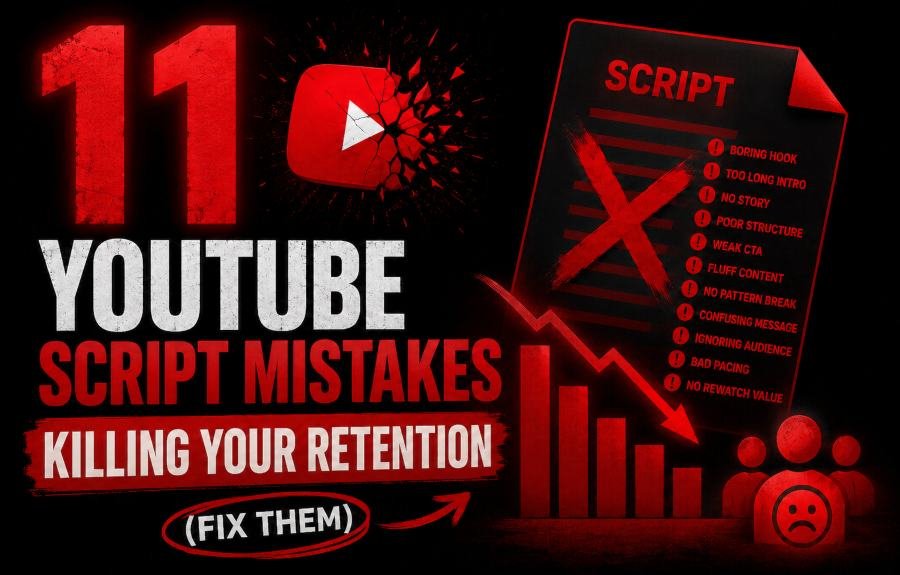
I've written 500+ YouTube scripts and analyzed retention data across 200+ videos. Here's what actually destroys watch time — and what top creators do instead.
Your script is the skeleton of every video you publish. And if that skeleton is broken, no amount of editing magic, great thumbnails, or perfect titles will save you.
I've spent years writing scripts, tearing them apart frame by frame, and mapping exactly where viewers drop off. The pattern is always the same: it's not one big mistake. It's a dozen small ones compounding into a retention disaster.
In this guide, I'm breaking down the 11 most common script mistakes I see — from creators with 1K subs to creators with 1M. I'll show you exactly what's wrong, why it hurts, and how to fix it.
Let's get into it.
This is the number one killer. I've analyzed retention curves on hundreds of videos, and the pattern is brutal: if you don't hook someone in the first 15 seconds, you've already lost them.
Most creators open with: "Hey guys, welcome back to the channel. Today we're going to talk about…"
That's not a hook. That's a warm-up. And your audience doesn't care about your warm-up.
What top creators do instead: they open with a curiosity gap or a bold claim that demands attention. Something like: "This one setting in Photoshop is destroying your portraits — and 90% of creators don't know it exists."
The hook isn't decoration. It's the entire reason someone keeps watching.
Before you write a single word of your script, write your hook first. If the hook isn't compelling, the rest of the script doesn't matter.
Here's a mistake I see constantly: creators write scripts that are essentially essays. Long paragraphs. No pauses. No visual cues. Just wall after wall of talking.
Your audience isn't reading your script — they're watching it. And the human brain processes visual and audio information in chunks. If you don't give your viewer a reason to look at something new every 30 to 60 seconds, their attention drifts.
The fix: write in visual beats. Every 30 to 60 seconds, your script should signal a change — a B-roll clip, a text overlay, a zoom cut, or a new example. Mark these in your script with [VISUAL: ___] so you remember during editing.
Think of your script like a movie screenplay, not a blog post.
Your hook makes a promise. Your script has to deliver.
I've seen too many videos where the opening says "I'm going to show you the exact method I used to get 100K views" — and then the video meanders through 12 minutes of tangents before barely touching the method in the last 30 seconds.
Viewers feel cheated. And they leave. They click away. They don't subscribe.
The fix: use the "Promise → Roadmap → Payoff" structure. First, promise in the hook: "I'll show you the 3-step method…" Then roadmap early: "Here's what we're covering: Step 1, Step 2, Step 3." Then deliver each step in order, on time.
This keeps viewers watching because they know exactly what they're waiting for.
This is subtle but deadly. Most scripts sound like the creator talking to themselves. They use insider jargon, skip context, and assume the viewer already knows what they know.
"So I was tweaking the curves and the luminance mask wasn't cooperating, so I just pushed the shadows…"
If your viewer isn't a professional colorist, they just checked out.
The fix: the "Explain It to a Friend" test. Read your script out loud. If you wouldn't say it to a smart friend who's interested in your topic but isn't an expert — rewrite it. Every technical term needs a one-sentence explanation the first time you use it.
"If you enjoyed this video, make sure to subscribe."
That CTA does nothing. It's a request with no value exchange. Why should someone subscribe? Not because you asked. Because you gave them a reason.
The fix: identity-based CTAs. Instead of "subscribe," try: "If you're the kind of creator who wants to grow on YouTube without burning out, you're in the right place. Hit subscribe so you don't miss next week's breakdown."
You're not asking for a subscription. You're telling them who they are if they subscribe. That's 10x more powerful.
Severity: 8/10 | Fix Difficulty: Medium
Here's where most creators go wrong: they write a script, film it, publish it, and never look at the retention graph.
Your retention graph is the report card for your script. Every dip tells you exactly where your script failed.
The fix: after every upload, screenshot your retention graph. Mark the drop-off points. Rewrite those sections in your next script. This is how you improve. Not by guessing — by reading the data.
Some creators find a script structure that works once and then use it for every single video. Same opening. Same transitions. Same CTA. Same everything.
Your audience notices. And YouTube's algorithm notices too — because repetitive content patterns signal low value.
The fix: keep your framework, vary your execution. Use the same skeleton (hook → roadmap → content → CTA) but change the pacing, the tone, and the delivery style every video. Surprise your audience.
If you memorize your script word for word, you'll sound robotic. I've watched hundreds of videos where the creator clearly memorized every line — and it kills the energy.
The fix: script in bullet points, not full sentences. Write: "Hook: mention the 3 settings that ruin portraits." "Point 1: curves adjustment — show before/after." Then talk naturally around those bullets. You'll sound like a person, not a teleprompter.
This is the mistake that costs you search traffic — and most creators completely ignore it. Your script should naturally include the keywords your target audience is searching for. But not stuffed — woven in.
The fix: use competitor tag data to find the exact phrases your audience searches for, then build them into your script naturally.
Here's how I do it personally: I grab the top 10 videos for my target keyword, extract their tags using the YouTube Tag Extractor, and identify the high-frequency tags. Those are the exact phrases I weave into my hook, my roadmap, and my body copy.For example, if I'm making a Photoshop retouching video, the extractor shows me that "portrait retouching photoshop 2025" and "frequency separation tutorial" are top tags across ranking videos. So I make sure those exact phrases appear in my script — not forced, but natural.
You can write the perfect script, film it beautifully, and publish it — but if your channel isn't monetized or that specific video gets flagged, you earn nothing.
I've seen creators pour weeks into a video only to find out it's demonetized because of a reused content flag or an authenticity issue they never checked.
The fix: before you publish, run your channel through the YouTube Monetization Checker. It tells you whether your channel is in the YouTube Partner Program, your authenticity score (this is huge — negative authenticity kills YPP applications), which videos are monetized and which aren't, and your estimated earnings.I run this before every major upload. It takes 10 seconds and saves me from wasting effort on videos that won't earn. Also — if your video suddenly stops getting views after you published it, don't assume it's the algorithm. Run it through the YouTube Shadowban Detector to check if YouTube is suppressing its visibility. I've caught shadowbans this way that I would have otherwise blamed on "bad timing."
This is the mistake that separates videos with 10K views from videos with 1M views. Most scripts are pure information. They teach, they explain, they deliver value — but they never make the viewer feel anything.
And here's the truth: people don't subscribe to channels. They subscribe to people they feel something for.
Your script needs at least one moment of genuine emotion — a personal story, a vulnerable admission, a moment of real excitement. Not performed. Real.
"Honestly, I almost quit YouTube last year. I had 200 subs and zero growth. But this one video changed everything…"
That moment is what turns a viewer into a subscriber.
Run through this before every upload. Creators who use 5 or more of these items see roughly 28% higher average view duration based on retention data I've tracked across my own channel and clients:
Your script isn't just words on a page. It's the blueprint for every second of your video. And every mistake in that blueprint shows up in your retention graph.
Stop guessing. Start auditing. Use the data. Fix the holes.
And if you want to go deeper — grab our script template ,learn the hook formulas that actually work , and read our full retention guide .Your next video deserves better than a script full of invisible mistakes.
Author
Lucas Reinhardt is a Digital Creator & YouTube Growth Specialist from the Netherlands
As Youtube Toolkit’s lead content writer, he transforms complex technical topics into engaging and helpful guides. His goal is to empower creators, coders, and marketers through clear and actionable content.
With 20+ years of experience in the digital ecosystem, Lucas specializes in bridging the gap between sophisticated technical architecture and practical end-user application. Whether it's deep-diving into YouTube SEO or exploring new SaaS integrations, his writing is designed to deliver immediate value.
Use our free tools to analyze, optimize, and maximize your YouTube channel's potential