
Sep 17, 2026
•
15 min read


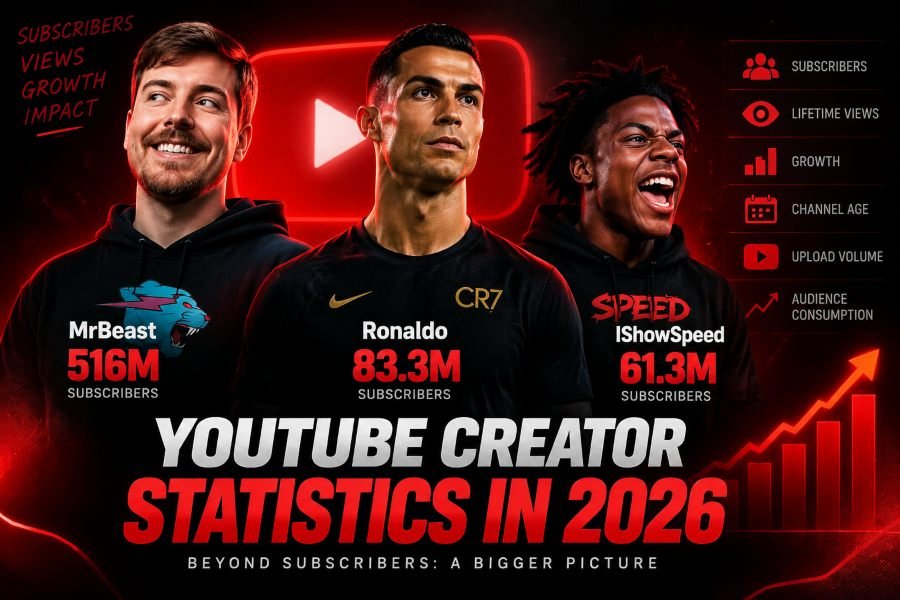
YouTube creator statistics in 2026 tell a more interesting story than a simple subscriber leaderboard.
MrBeast has about 516 million subscribers, Cristiano Ronaldo has roughly 83.3 million, and IShowSpeed has around 61.3 million. Ranking those three by subscribers seems straightforward. But the picture changes when you look at lifetime views, current viewing activity, channel age, publishing volume, and how each audience was built.
Ronaldo has about 22 million more subscribers than IShowSpeed. Yet Speed's main channel has generated more than 10.8 billion lifetime views, compared with roughly 1.65 billion for Ronaldo.
MrBeast operates on another level again, with nearly 140 billion lifetime views and more than half a billion subscribers.
That is why this report does not treat subscriber count as the final answer.
Instead, it examines three questions: How rare are YouTube's major subscriber milestones? Who actually leads the creator rankings in 2026? And what happens when you compare creators by scale, growth, and audience consumption rather than subscribers alone?
The results show that one million subscribers is far rarer than YouTube's homepage makes it look, the world's largest channels are not always the world's largest individual creators, and "fastest-growing YouTuber" can mean several completely different things.
YouTube creator statistics measure the size, activity, growth, and viewing history of a channel. Subscriber count is only one part of that picture.
The most visible metric is subscribers. It tells you how many people have chosen to follow a channel and gives a useful measure of accumulated audience scale.
But subscribers do not tell you how many of those people are still watching.
Lifetime views measure how much viewing a channel has accumulated over time. Recent views tell you more about current attention. Upload volume shows how much content exists to generate those views.
Channel age adds another layer. A channel operating for 12 years has had far more time to accumulate subscribers and views than one created two years ago.
Content format matters too. A creator publishing high-budget long-form videos behaves differently from a livestreamer uploading frequently or a media company publishing dozens of videos every day.
This is why two channels with similar subscriber counts can have completely different performance profiles.
The same problem appears at the very top of YouTube.
MrBeast is the largest channel by subscribers, with about 516 million. T-Series sits far behind at around 315 million.
But T-Series has accumulated approximately 355 billion channel views, while MrBeast is approaching 140 billion.
Both statements are true.
MrBeast is much larger by subscribers. T-Series is much larger by lifetime viewing.
Any useful set of YouTube channel statistics therefore needs to state exactly what "biggest," "fastest," or "most successful" means.
YouTube makes enormous channels feel normal because its recommendation system naturally exposes viewers to successful creators.
The actual distribution looks very different.
A July 2026 dataset covering 61,186,246 YouTube channels with at least one public subscriber shows how rapidly the creator pyramid narrows as subscriber counts rise.
At 100 subscribers, about 41.75 million channels had reached or passed the milestone. That represented approximately 68.2% of the analyzed channels.
At 500 subscribers, the population dropped to roughly 29.65 million, or 48.5%.
At 1,000 subscribers, about 24.81 million channels remained. That means only 40.6% of the sample had reached the familiar 1K milestone.
The decline becomes much steeper after that.
Only about 4.84 million channels had reached 10,000 subscribers. That represents roughly 7.9% of the analyzed population.
At 100,000 subscribers, the number falls below one million channels. Around 792,376 channels had reached that level, representing only 1.3% of the sample.
Then comes the milestone that YouTube culture often makes look almost ordinary: one million subscribers.
Only 79,570 channels in the 61.2-million-channel dataset had at least one million subscribers.
That is roughly 0.13%.
Put another way, only about 13 channels out of every 10,000 in the analyzed sample had reached one million subscribers.
At 10 million subscribers, the group becomes tiny.
Only 3,082 channels had crossed 10 million. That is about 0.005% of the sample.
At 100 million subscribers, there were just 17 channels in the July 2026 dataset.
This changes how creator size should be interpreted.
A creator with 100,000 subscribers may look relatively small next to MrBeast, IShowSpeed, or Ronaldo. In platform-wide terms, however, that channel has already reached a level achieved by only about 1.3% of the analyzed population.
A one-million-subscriber creator sits in an even narrower group.
That is the real shape of the YouTube Creator Pyramid.
The bottom contains tens of millions of channels. The middle contracts rapidly. By the time you reach 10 million subscribers, almost everyone has disappeared.
MrBeast's half-billion audience sits so far above the normal distribution that it is more useful to treat him as an extreme statistical outlier than as a realistic benchmark for an ordinary creator.
Large creators can add enormous numbers of subscribers while still showing slower percentage growth.
That sounds contradictory until you look at the denominator.
A separate 2026 analysis of around 11.75 million active channels found that channels starting with 1 to 99 subscribers had median monthly percentage growth of roughly 1.26%.
Channels between 1,000 and 9,999 subscribers were closer to 0.51%.
For channels between 100,000 and 999,999 subscribers, median monthly growth fell to roughly 0.30%.
Channels already above one million subscribers showed median monthly percentage growth of about 0.24%.
The larger channels were not necessarily performing worse.
They simply needed far more new subscribers to move the percentage.
A channel with 100 subscribers needs one additional subscriber to grow by 1%.
A channel with 100 million subscribers needs one million additional subscribers to achieve the same percentage increase.
That is why growth comparisons should use both absolute gains and percentage growth.
A 10% month can be extraordinary for a mature multi-million-subscriber channel. The same percentage may require only a handful of subscribers for a brand-new channel.
This distinction becomes especially important when people try to rank the fastest-growing YouTubers.
MrBeast is the most-subscribed YouTube channel in September 2026, with approximately 516 million subscribers.
The current global subscriber ranking starts with:
The gap between first and second place is striking.
MrBeast leads T-Series by approximately 201 million subscribers. His subscriber audience is roughly 64% larger than the second-ranked channel.
But this ranking also exposes a classification problem.
A list of the biggest YouTube channels is not automatically a list of the biggest YouTube creators.
T-Series is a music company. Cocomelon is an entertainment brand. SET India is a television network. YouTube Movies is not an individual creator in any meaningful sense.
MrBeast is personality-led. So are creators such as IShowSpeed and Cristiano Ronaldo.
Vlad and Niki, Stokes Twins, Kids Diana Show, and Like Nastya are also creator-led properties, though several have grown into larger entertainment operations.
This distinction matters because searchers use phrases such as "top YouTube creators," "biggest YouTubers," and "most subscribed YouTubers" as if they mean the same thing.
They do not.
For a pure channel ranking, corporate and media accounts belong in the list.
For an individual creator ranking, they need to be separated.
MrBeast has approximately 516 million subscribers, nearly 140 billion lifetime views, and about 1,000 public videos as of September 2026.
Jimmy Donaldson's main channel was created in February 2012, giving MrBeast more than 14 years of YouTube history.
His biggest milestone of 2026 came on June 12, when he became the first individual YouTube creator to reach 500 million subscribers.
That milestone followed two earlier changes at the top of YouTube.
MrBeast became the platform's most-subscribed individual creator in November 2022. In June 2024, he passed T-Series and became YouTube's most-subscribed channel overall.
Crossing 500 million placed him in territory no individual creator had reached before.
His current public count of around 516 million means another roughly 16 million subscribers have appeared on the public counter since the 500M milestone.
The raw subscriber number is impressive, but MrBeast's publishing model is just as interesting.
His main channel has around 1,000 public videos.
T-Series has more than 27,000.
Despite that enormous difference in content inventory, MrBeast has accumulated almost 140 billion views.
That means his growth does not depend on industrial-scale publishing.
The model is closer to event television.
Individual videos are designed to attract huge global audiences, often through concepts that require little cultural or linguistic explanation: large competitions, survival challenges, transformations, expensive experiments, creator collaborations, and spectacle.
That helps explain why MrBeast works so well across international audiences.
You do not need deep knowledge of an ongoing story to understand the premise of someone competing for a million dollars or surviving an extreme challenge.
His statistics therefore represent a specific kind of creator growth: platform-native compounding at global scale.
The audience was built primarily through repeated YouTube performance over many years. Each successful release enlarged the potential audience for the next one.
By subscribers, yes.
By lifetime views, no.
That difference is one of the best examples of why a single YouTube ranking can be misleading.
MrBeast has about 516 million subscribers, compared with roughly 315 million for T-Series.
The advantage is enormous.
Yet T-Series has accumulated around 355 billion lifetime views, more than twice MrBeast's roughly 140 billion.
The reason becomes clearer when you compare publishing models.
T-Series operates a huge music catalog and has uploaded more than 27,000 videos. MrBeast's main channel has around 1,000.
T-Series can generate views across thousands of songs, movie clips, music videos, and catalog content every day.
MrBeast concentrates attention into a far smaller number of releases.
So which channel is bigger?
If the metric is subscribers, MrBeast.
If the metric is lifetime views, T-Series.
If the question is largest individual creator, MrBeast is again the clearer answer because T-Series is an organization rather than an individual personality.
This is why the metric and entity type should always be attached to a YouTube ranking.
Cristiano Ronaldo's UR · Cristiano channel has approximately 83.3 million subscribers, about 1.65 billion lifetime views, and only 146 public videos.
The channel was created in July 2024.
That makes its current scale extraordinary.
Ronaldo built an 83-million-subscriber YouTube audience in little more than two years while publishing a fraction of the content found on many older creator channels.
His defining statistic, however, is not the current total.
It is the speed of the launch.
When UR · Cristiano launched in August 2024, Ronaldo gained 19,729,827 subscribers within the first 24 hours.
Six days after launch, the channel had already passed 48 million subscribers.
That growth pattern is fundamentally different from MrBeast's.
MrBeast's YouTube audience compounded over more than a decade.
Ronaldo arrived with an enormous audience already waiting.
He had decades of global football recognition, hundreds of millions of social followers, major sponsorships, constant media coverage, and fan communities in virtually every major market.
His YouTube channel did not have to introduce Cristiano Ronaldo to the internet.
It only had to convert part of an existing global audience into YouTube subscribers.
That model can be described as imported scale.
The subscribers are real YouTube subscribers, but much of the demand existed before the YouTube channel.
This explains why copying Ronaldo's upload strategy would tell another creator almost nothing.
The lesson is not that publishing a small number of videos can generate tens of millions of subscribers.
The real lesson is that pre-existing attention can dramatically compress the time needed to build a new platform audience.
Ronaldo owns one of YouTube's most extraordinary launch records, but launch growth and current growth are not the same metric.
This distinction is often lost in fastest-growing YouTuber rankings.
A creator can gain millions of subscribers during a major launch, viral event, or cultural moment and then settle into a much slower long-term growth curve.
Ronaldo's first 24 hours were exceptional because millions of existing fans subscribed almost simultaneously.
By September 2026, his public subscriber count was around 83.3 million.
That is still an enormous audience, but the channel is no longer adding subscribers at anything close to the first-day pace.
This is exactly what you would expect.
The highest-intent Ronaldo fans had already subscribed early. Future growth increasingly depends on continued content consumption, new viewers, promotion, collaborations, and YouTube's own recommendation system.
So Ronaldo should be described precisely.
He is one of the clearest examples of record-breaking launch velocity.
That does not automatically make him the creator with the highest current monthly growth in September 2026.
IShowSpeed has approximately 61.3 million subscribers, more than 10.8 billion lifetime views, and close to 2,000 public videos on his main channel.
His channel dates back to March 2016.
Speed's numbers are particularly useful because they reveal something subscriber rankings hide.
Cristiano Ronaldo has around 22 million more subscribers than IShowSpeed.
Yet IShowSpeed has accumulated more than six times as many lifetime channel views.
That does not automatically mean Speed is a "bigger" global celebrity.
It means YouTube audiences have consumed the two channels in very different ways.
Speed's rise has been heavily tied to repeated platform consumption.
Gaming created the original foundation. Livestreaming then became central to his identity.
Football culture brought him into a wider international conversation. His public admiration for Cristiano Ronaldo itself became part of the entertainment.
Travel streams expanded the audience again.
Instead of producing content only from a studio, Speed increasingly turned countries, crowds, sporting events, public encounters, and unpredictable real-world situations into live entertainment.
That creates a very different audience relationship from a channel built around occasional polished uploads.
Viewers may watch for hours rather than minutes.
They may return repeatedly during the same week.
Individual moments from long streams can also spread through Shorts, clips, reposts, social media, and reaction channels.
By early 2026, IShowSpeed crossed 50 million subscribers.
By September, the public counter was around 61.3 million.
His channel also continued producing major live-viewing events throughout the year.
That makes Speed a strong example of consumption-led personality growth: the creator's personality is effectively the format, allowing gaming, football, travel, challenges, and live interaction to coexist under one channel identity.
The answer depends entirely on what you measure.
This is why I use a simple framework for creator comparisons: Scale, Velocity, and Consumption, or SVC.
It avoids pretending that one number can describe the entire strength of a creator.
Scale is the easiest dimension.
MrBeast leads with approximately 516 million subscribers.
Cristiano Ronaldo has around 83.3 million.
IShowSpeed has roughly 61.3 million.
By pure subscriber scale, the ranking is clear.
MrBeast is more than six times larger than Ronaldo and more than eight times larger than Speed.
Ronaldo has roughly 36% more subscribers than Speed.
If all you want is a subscriber ranking, you can stop there.
But that would miss most of what makes the comparison interesting.
Velocity measures recent movement rather than accumulated history.
A useful velocity window needs to be fixed. Seven days, 28 days, or 30 days can all work, but the same period should be used for every creator.
Recent public channel data shows MrBeast adding enormous numbers of views even with a 500M-plus subscriber base.
During an early-September 2026 observation window, his channel frequently recorded daily view increases measured in the tens of millions. Some reporting days exceeded 100 million additional channel views.
IShowSpeed was operating at a much smaller overall scale but still regularly adding millions of channel views per day.
Ronaldo's channel showed a far lower recent view velocity during the same general period.
That does not invalidate Ronaldo's 83.3 million subscribers.
It reveals that a subscriber base and an active viewing audience are not interchangeable.
A channel can have an enormous accumulated audience while publishing less frequently or generating less daily consumption.
Another creator can have fewer subscribers while producing far more current viewing activity.
Velocity therefore answers a different question:
Who is generating attention now?
Lifetime consumption creates another ranking.
MrBeast has approximately 139.8 billion lifetime channel views.
IShowSpeed has around 10.8 billion.
Ronaldo has approximately 1.65 billion.
A simple descriptive calculation produces an interesting result.
MrBeast has roughly 271 lifetime channel views for every current subscriber.
IShowSpeed is around 177.
Ronaldo is closer to 20.
These numbers are not engagement rates.
A subscriber can watch hundreds of videos. Non-subscribers can generate views. People can unsubscribe. Shorts, livestreams, repeat views, and years of historical traffic all contribute.
The calculation is useful for only one purpose: showing how different the viewing history behind each subscriber base can be.
Ronaldo's subscriber count grew extraordinarily fast because the audience already existed elsewhere.
Speed's audience was built through years of repeated content consumption.
MrBeast combines huge audience scale with a massive accumulated viewing history.
The SVC framework therefore gives each creator a different profile.
MrBeast represents compounding scale.
Ronaldo represents imported scale.
IShowSpeed represents high-consumption personality scale.
None of those models can be understood from subscriber count alone.
These three creators demonstrate that there is no single route to becoming one of YouTube's biggest personalities.
MrBeast shows what happens when YouTube-native distribution compounds for more than a decade.
His videos grew bigger, the production became more ambitious, the concepts became easier to understand globally, and the audience expanded across countries and languages.
Ronaldo demonstrates something almost opposite.
He did not need YouTube to create his fame.
YouTube became another destination for an audience already built through football, traditional media, Instagram, sponsorships, clubs, national teams, and global sports culture.
Speed represents a third model.
His audience is strongly tied to continuous participation in internet culture.
A football match, Minecraft marathon, overseas trip, fan interaction, celebrity encounter, or unexpected live moment can all become content.
The important difference is not simply format.
It is how the audience relationship was created.
MrBeast primarily compounds distribution.
Ronaldo transfers existing attention.
Speed repeatedly renews attention through personality-driven consumption.
That is why the same subscriber metric behaves differently for all three.
There is no responsible answer to "fastest-growing YouTuber" without defining the timeframe and measurement.
A 24-hour ranking can produce one winner.
A 30-day ranking can produce another.
Percentage growth can favor a smaller channel, while absolute subscriber gains favor a much larger creator.
Recent views can create an entirely different leaderboard.
Cristiano Ronaldo is the obvious example of launch velocity because of his 19.7-million-subscriber first day.
MrBeast is more relevant when discussing growth at extreme scale. Adding even 1% to a 500-million-subscriber audience requires roughly five million additional subscribers.
IShowSpeed provides a stronger example of high current consumption and rapid creator-led expansion, especially when major livestreams and international content push the channel into new audiences.
So when you encounter a list of the fastest-growing YouTubers, check what it actually measures.
"Fastest growing" could mean most new subscribers, highest percentage increase, most new views, fastest milestone achievement, or biggest launch.
Those categories should not be mixed.
YouTube subscriber records become clearer when they are separated by record type.
MrBeast owns the modern scale record.
He is YouTube's most-subscribed channel and became the first individual creator to cross 500 million subscribers in June 2026.
Cristiano Ronaldo owns the standout 24-hour acquisition record, gaining 19,729,827 subscribers during the first day of UR · Cristiano.
These records measure different achievements.
MrBeast's number represents years of cumulative growth.
Ronaldo's record measures how quickly an audience moved onto a new channel.
Historical subscriber records should also always include a date.
A verified record may show an older total while the current public channel count has already moved far beyond it.
That does not mean one number is incorrect.
One is a verified historical snapshot. The other is a current public statistic.
The date is part of the data.
YouTube's standard Creator Award system recognizes four major subscriber levels.
The Silver Creator Award begins at 100,000 subscribers.
The Gold Creator Award begins at 1 million.
The Diamond Creator Award begins at 10 million.
The Red Diamond Creator Award begins at 100 million.
Those numbers become more meaningful when placed back into the creator pyramid.
A Silver-level subscriber count of 100K was reached by only about 1.3% of channels in the 2026 benchmark sample.
At one million, the share fell to about 0.13%.
At ten million, it was approximately 0.005%.
At 100 million, only 17 channels appeared in the analyzed dataset.
Subscriber count alone does not automatically guarantee an award. Channels still need to satisfy YouTube's eligibility and policy requirements.
That distinction matters because people often describe Play Buttons as if they are triggered automatically the moment a counter changes.
The subscriber threshold makes a creator eligible for the corresponding level. YouTube still reviews the channel.
Subscriber count measures accumulated audience intent.
It does not measure guaranteed current attention.
Someone may have subscribed five years ago and no longer watch the channel. A viewer may watch every upload without subscribing. Shorts can generate subscribers differently from long-form videos. Livestream audiences can spend hours with a creator without changing the subscriber count at all.
Channel age introduces another distortion.
IShowSpeed's channel has existed since 2016.
Ronaldo's official channel began in 2024.
Comparing their lifetime views without considering those additional years would be incomplete.
Upload inventory matters as well.
Speed has close to 2,000 public videos.
Ronaldo has 146.
Those channels have had dramatically different opportunities to accumulate views.
The same principle applies to MrBeast and T-Series.
T-Series has tens of thousands of uploads. MrBeast has around one thousand.
Subscriber rankings are therefore useful for answering one narrow question:
How large is the channel's accumulated subscribed audience?
They are not a complete creator valuation system.
No.
Public subscriber counts for larger YouTube channels are rounded.
That matters much more than it first appears.
YouTube's public channel data rounds subscriber counts down to three significant figures.
For a smaller channel, that may still leave useful precision.
For an enormous channel, each visible movement can represent hundreds of thousands or even millions of subscribers.
A public display of 516M should therefore not be interpreted as exactly 516,000,000 subscribers.
Likewise, IShowSpeed showing 61.3M does not mean the underlying count is exactly 61,300,000.
This creates a common analytical mistake.
Suppose a creator's public subscriber count displays the same number for three days.
That does not mean the channel gained zero subscribers during those three days.
The exact total can keep increasing without crossing the next public rounding threshold.
The opposite happens when the display changes.
A jump from 515M to 516M does not prove that exactly one million subscribers arrived on that specific day.
The underlying number simply crossed the threshold needed for the public representation to change.
For precise subscriber acquisition data, first-party YouTube Studio analytics is much more useful than a public counter.
Public counts are still excellent for rankings and broad comparisons.
They just should not be treated as exact real-time analytics.
There is another measurement issue specific to 2026.
YouTube changed how public channel views are counted beginning in August 2026.
For long-form videos, livestreams, and Shorts, public view counting was aligned so a view can be recorded when playback begins, including supported autoplay and other playback starts.
That means a researcher comparing channel-view trends across the change should be careful.
The number labeled "views" still represents views.
But the measurement definition is not perfectly identical across every historical period.
This does not make current rankings unusable.
It means the date of the data matters.
It also reinforces a broader rule for YouTube creator statistics:
Never separate a large number from its definition.
A subscriber count needs a date.
A growth rate needs a timeframe.
A view total needs measurement context.
A creator ranking needs to state whether it includes companies and media brands.
The more precise the question, the more useful the statistic becomes.
If you are comparing YouTube creators for sponsorships, research, competitive analysis, or channel strategy, subscriber count should be the beginning rather than the end.
Start with scale.
How many subscribers does the creator currently have?
Then examine recent attention.
How many views have the latest videos generated? What has happened over the last seven, 28, or 30 days?
Look at publishing behavior.
Does the creator upload once a month, every day, or spend dozens of hours livestreaming?
Separate formats.
A channel dominated by Shorts should not automatically be compared with a long-form documentary creator using the same assumptions.
Consider channel age.
A channel with 10 billion lifetime views accumulated over 12 years tells a different story from one that reached the same figure in three years.
Finally, look at the direction of the audience.
Is viewership accelerating, stable, or declining?
Those questions make creator statistics useful for decisions rather than trivia.
Several numbers provide a useful snapshot of where YouTube stands in September 2026.
MrBeast is the most-subscribed channel at approximately 516 million subscribers.
T-Series remains second by subscribers at roughly 315 million, but leads major channels in lifetime viewing with around 355 billion views.
Cocomelon has approximately 202 million subscribers and more than 227 billion lifetime views.
Cristiano Ronaldo's UR · Cristiano sits at roughly 83.3 million subscribers, despite launching only in 2024.
IShowSpeed has around 61.3 million subscribers and more than 10.8 billion lifetime channel views.
Ronaldo holds the standout 24-hour subscriber acquisition record at 19,729,827 subscribers.
MrBeast became the first individual creator to reach 500 million subscribers in June 2026.
At the other end of the creator pyramid, the milestone data is just as revealing.
Only 7.9% of channels in the large 2026 benchmark sample had reached 10,000 subscribers.
Only 1.3% had reached 100,000.
Only 0.13% had reached one million.
Only 3,082 channels had reached ten million.
Only 17 had reached 100 million.
Those numbers provide the context missing from most celebrity rankings.
MrBeast is the most-subscribed YouTube channel and individual creator in September 2026, with approximately 516 million subscribers.
T-Series is second at around 315 million, leaving MrBeast with a lead of roughly 201 million subscribers.
MrBeast has approximately 516 million public subscribers as of September 2026.
His main channel has also accumulated nearly 140 billion lifetime views and contains around 1,000 public videos.
Because YouTube rounds public subscriber counts, 516M should be treated as a public approximation rather than an exact real-time Studio figure.
Cristiano Ronaldo's UR · Cristiano channel has approximately 83.3 million subscribers.
The channel has generated around 1.65 billion lifetime views from only 146 public videos.
Ronaldo also holds the record for gaining 19,729,827 YouTube subscribers within 24 hours.
IShowSpeed has approximately 61.3 million YouTube subscribers as of September 2026.
His main channel has accumulated more than 10.8 billion lifetime views and contains close to 2,000 public videos.
It depends on how "bigger" is defined.
Cristiano Ronaldo has approximately 22 million more YouTube subscribers than IShowSpeed.
IShowSpeed, however, has more than six times Ronaldo's lifetime channel views.
Ronaldo leads in subscriber scale. Speed leads strongly in accumulated YouTube viewing.
Cristiano Ronaldo holds the major verified 24-hour record with 19,729,827 subscribers gained after launching UR · Cristiano in August 2024.
His channel passed 48 million subscribers within six days.
A July 2026 dataset covering more than 61 million channels found 79,570 channels with at least one million subscribers.
That represented approximately 0.13% of the analyzed sample.
Approximately 792,376 channels, or 1.3% of the large 2026 benchmark sample, had reached 100,000 subscribers.
That means a channel at the 100K level was ahead of roughly 98.7% of channels included in that dataset.
Only 3,082 channels in the July 2026 benchmark had reached at least 10 million subscribers.
That represented approximately 0.005% of the analyzed channels.
YouTube's major Creator Award thresholds are 100,000 subscribers for Silver, 1 million for Gold, 10 million for Diamond, and 100 million for Red Diamond.
Channels must also meet YouTube's eligibility requirements before an award is issued.
They are accurate enough for public rankings but are not exact at large channel sizes.
YouTube rounds public subscriber counts down to three significant figures. The exact subscriber total available to a channel owner inside YouTube Studio can therefore differ from the public number.
There is no single correct answer without specifying a timeframe and metric.
Fastest growth could mean subscribers gained in 24 hours, monthly subscriber additions, percentage growth, recent views, or speed to a major milestone.
Cristiano Ronaldo is the standout example of launch speed, while creators such as MrBeast and IShowSpeed demonstrate different forms of sustained growth and current audience activity.
The most useful finding from YouTube creator statistics in 2026 is not simply that MrBeast has more than half a billion subscribers.
It is that YouTube scale can be built in fundamentally different ways.
MrBeast shows what long-term platform-native compounding can produce. More than a decade of increasingly ambitious videos turned one creator into YouTube's first 500-million-subscriber individual.
Cristiano Ronaldo shows the power of existing global attention. He arrived with an audience already built through football and converted almost 20 million people into YouTube subscribers within a single day.
IShowSpeed shows how repeated consumption can create another kind of creator power. He has fewer subscribers than Ronaldo but vastly more lifetime YouTube views, built through years of gaming, livestreaming, travel, football culture, and personality-driven entertainment.
Subscriber counts remain valuable.
They tell you how much audience a channel has accumulated.
But they become far more useful when combined with velocity, consumption, channel history, and content format.
That is also why YouTube's subscriber pyramid matters.
One million subscribers is not ordinary.
Ten million is exceptionally rare.
One hundred million places a channel inside a tiny global group.
And MrBeast's 500-million-plus audience sits so far above the normal creator distribution that it should not be treated as the standard every creator is expected to chase.
The better question is not simply "Who has the most subscribers?"
It is "What kind of audience has this creator built, how active is that audience now, and how did the channel reach its current scale?"
Those questions turn YouTube creator statistics from impressive numbers into useful information.
Author
Youtube Toolkit Team is a Digital Creator & YouTube Growth Specialist from the Netherlands
As Youtube Toolkit’s lead content writer, he transforms complex technical topics into engaging and helpful guides. His goal is to empower creators, coders, and marketers through clear and actionable content.
With 20+ years of experience in the digital ecosystem, Lucas specializes in bridging the gap between sophisticated technical architecture and practical end-user application. Whether it's deep-diving into YouTube SEO or exploring new SaaS integrations, his writing is designed to deliver immediate value.

Use our free tools to analyze, optimize, and maximize your YouTube channel's potential