
Sep 22, 2026
•
10 min read

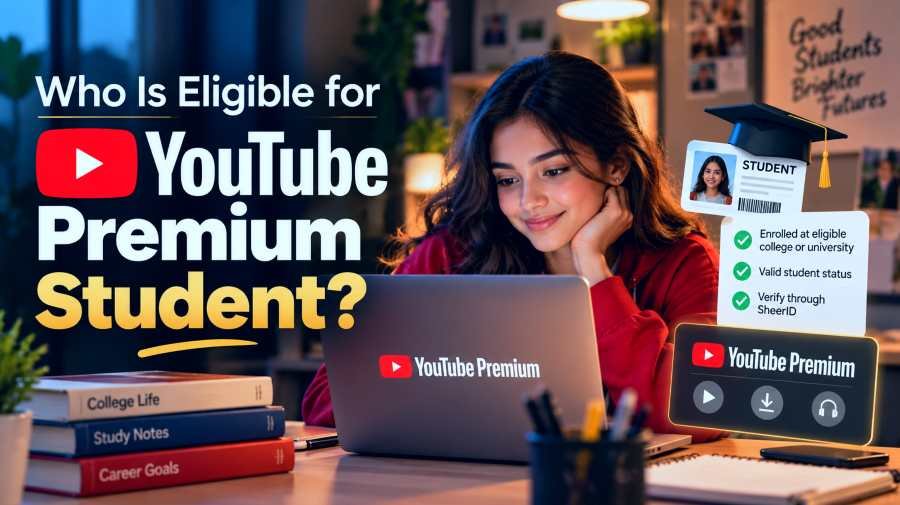
To get a YouTube Premium student membership, you must be a full-time student at an approved higher-education institution in a country where YouTube offers student memberships; SheerID also needs to verify your student status.
It is easy to miss that only full-time students are eligible, even though YouTube's Help page doesn't use the term "full-time." The Paid Service Terms do, so following the stricter rule helps you clearly understand your eligibility.
If you are eligible, YouTube will let you keep a student membership for up to four years continuously, but you'll need to check your eligibility each year.
Before you try to sign up, make sure you meet these four requirements:
All of these conditions matter; simply being a college student does not entitle you to the discount. Your college, enrollment status, location, and verification process all matter.
YouTube's public Help page states that you must be a student at a higher-education institution in a place where student memberships are available.
The current YouTube Paid Service Terms are more detailed; in the section on Student Plans, YouTube states that student memberships are available only to full-time students at approved higher-education institutions.
This is not merely wording from a separate Google One or Google AI student promotion. The February 11, 2026 document is titled YouTube Paid Service Terms of Service, says it applies to all Paid Services, and contains additional terms specifically for YouTube Premium, YouTube Music Premium, and YouTube Premium Lite.
In practice, you need to verify two things: whether your education qualifies as higher education and whether you meet YouTube's full-time requirement.
The number of students enrolled in a standard high school does not meet YouTube's published requirement that the student attend a higher-education institution.
Therefore, if you're a high school student, it's wrong to think that having a student ID, a school email address, or enrollment is enough, since your education level doesn't meet YouTube's requirement.
The YouTube Help page doesn't address part-time students separately, even though the current Paid Service Terms state that student memberships are only available to full-time students.
Under the terms YouTube currently publishes, part-time enrollment does not meet that condition, and the fact that SheerID confirms a person attends a school alone would not be sufficient to meet YouTube's eligibility requirements for its student plan.
SheerID also states that each brand can set its own rules for student offers; thus, SheerID's general criteria do not replace YouTube's specific requirements.
On its main Help page for student members, YouTube does not distinguish between undergraduate, master's, and doctoral students.
For graduate or PhD students, you must follow the same rules: study full-time at an approved higher education institution in a supported location and pass SheerID verification. You shouldn't assume your degree level alone makes you eligible.
YouTube doesn’t provide a clear list showing which community colleges, online universities, vocational programs, or trade schools qualify.
First, verify that your school meets YouTube's higher-education requirement and appears on the SheerID form; if it does, YouTube says student plans are available for your school.
YouTube links its location requirement to whether a person is enrolled at a higher-education institution in a place where it provides student memberships. This is more accurate than just stating that "your location" must be supported.
On October 3, 2026, YouTube's Help page states that student memberships are available in several countries and regions, such as Bangladesh, India, Pakistan, the United States, the United Kingdom, Canada, Australia, Singapore, Japan, Germany, France, Malaysia, and many other places.
Because the list of supported countries and regions may change over time, it is important to check YouTube's current Help page before attempting to subscribe. This ensures you have the latest information on where student memberships are available, helping readers avoid confusion or failed verification.
The general geographic terms for YouTube Premium also state that Premium Services should usually be used in the country or region where you originally signed up, and that moving to a different country might mean you have to resubscribe there. This is a general geographic rule for Premium, not a separate rule for student verification, so I should not infer any more specific restrictions for international students than those YouTube actually publishes.
If your next question is how Premium pricing differs between countries, see YouTubeToolkit’s guide to YouTube Premium price changes across multiple countries in 2026. Pricing is a separate issue from student eligibility and can vary significantly by market.
YouTube verifies student eligibility using SheerID.
To check whether student memberships are available through your institution:
YouTube says student plans will be available for that school if it appears on the list, and adds that SheerID decides whether the school is eligible.
When entering your school's name, use the full official name rather than a shortened form, so SheerID can accurately verify your institution and you can feel confident in your accuracy.
Try the search again using the full name of the institution.
If the institution still doesn't show up, don't assume uploading a school ID will automatically satisfy the institution requirement, since YouTube's Help page says SheerID must approve the institution, and SheerID determines eligibility.
For verification issues, YouTube directs users to SheerID and currently lists customerservice@sheerid.com as the verification-support contact.
When your institution is available, SheerID will verify whether you satisfy the student-verification requirements.
YouTube has a specific sign-up process for students for both YouTube Premium and YouTube Music Premium. Once you've selected the student option, you'll go through SheerID; if SheerID verifies you right away, you'll be redirected to YouTube to complete sign-up.
If SheerID can't verify you right away, YouTube may ask you to send extra documentation, which will be reviewed manually.
Timing varies: YouTube says you'll receive an email within 20 minutes in the United States, while in other locations the email notification may take up to 48 hours.
This means you should not automatically treat a manual review without an immediate answer as a rejection.
Verification isn't the last step in the purchase process.
YouTube states that if your eligibility is confirmed through the additional verification process, you must log back into your account, open your profile, select Paid memberships, and then follow the notification that asks you to complete the signup.
Then select or enter a payment method and click Buy to complete the membership purchase.
YouTube has confirmed that SheerID might ask for additional documentation, but the YouTube Help page does not include a full list of documents specific to YouTube.
SheerID’s general Student FAQ says that when documentation is requested, it should be school-issued and show:
Examples of SheerID include a school ID card which has an expiry date, a class timetable, and a tuition receipt.
The main point is current enrollment; if a document names your school but doesn't show current enrollment, it may not include the information SheerID requires.
The student advice provided for each offer also states that the date of enrollment matters more than the date you printed the document. For instance, a transcript you just downloaded that shows only a previous term does not necessarily prove you are currently enrolled. Similarly, future acceptance alone may not be enough to show that a person is already enrolled.
When entering your name during the verification process, make sure it matches the name on your school records. SheerID suggests using the same information as on your documents.
These are SheerID's general guidelines, since not every example document will be accepted for every YouTube student application.
Instead of assuming each student type has its own rules, follow the requirements YouTube lists step by step.
You will be eligible if your higher-education institution is in a supported area, appears on SheerID, and your student status can be verified.
You must be a full-time student, but you still need to check your school and complete verification.
A typical high school student does not meet the requirements of the higher education institution stated.
The fact that "student membership" is called that doesn't mean it covers all levels of education.
The YouTube article doesn't mention part-time study, even though the current terms state that only full-time students are eligible for student memberships.
Based on the published terms, a part-time student is not considered a full-time student.
Graduate study is part of higher education, but YouTube doesn't have a special rule that automatically approves graduate or PhD students.
A graduate student working full-time should still verify the institution's requirements, the supported location, and SheerID verification.
Merely studying online does not ensure you will receive a student membership.
What counts is whether you are employed full-time, whether your school is approved, whether the location is supported, and whether SheerID can verify you.
YouTube has no rule stating that all international students qualify or are excluded.
Handle the institution and student status the same way the requirements are documented. Also keep in mind that YouTube's general Premium terms include geographic rules based on the country where the Premium Service is purchased and mainly used.
Just because you've been approved once doesn't mean that you'll always receive the discount.
YouTube states that eligible users may keep their student membership for up to four consecutive years and must re-verify their eligibility each year.
Verify your status each year because it could change; for example, you might graduate, change your enrollment, leave the school, or stop meeting the requirements.
Being enrolled in a school doesn't automatically grant you another year of the discount; you must meet all requirements each time you verify.
The YouTube Help page states that you can get a student membership for up to four consecutive years if you meet the eligibility criteria, and you will need to re-verify your details each year during that time.
The phrase "up to four consecutive years" is significant, and I wouldn't rephrase it as an unlimited discount that continues as long as you stay in school.
A degree taking longer than four years does not mean the YouTube student rate will continue indefinitely.
YouTube's Terms of Service state that if you no longer qualify for the discounted student rate, you can switch to another membership.
One important exception applies by location: YouTube states that in certain places, such as Quebec and Israel, a student membership ends when the user is no longer eligible.
People should verify their membership status before renewing rather than assume that every account converts automatically in the same way.
Yes, if you already have an active paid YouTube membership and want to switch to a student membership, you must first cancel your current subscription, then register for the student plan.
A sensible order is:
One exception applies: the cancel-first rule for YouTube does not extend to NFL Sunday Ticket or YouTube TV, since these services are not ordinary Premium subscriptions in this regard.
YouTube provides a student discount for YouTube Music via a YouTube Music Premium student membership.
The YouTube Help article covers student eligibility for both YouTube Premium and YouTube Music Premium, including the higher-education requirement, the SheerID institution check, verification, the need for annual re-verification, supported locations, and the four years.
The two membership options differ because YouTube Premium offers benefits on both YouTube and YouTube Music, while Music Premium is for music only.
If you want a discounted Music subscription, you will still need to complete the same student verification process.
YouTube does not state that having a .edu email address is sufficient proof of eligibility for the student membership.
YouTube determines eligibility based on your enrollment in a higher education program, the result of the SheerID school check, and successful completion of the student verification process.
The number of students enrolled in a standard high school does not meet YouTube's requirement that the student be enrolled in a higher-education institution.
The YouTube Help article doesn't mention part-time students, even though the terms state that only full-time students at approved higher-education institutions are eligible for student memberships. Enrollment on a part-time basis does not satisfy this requirement.
You may be asked to submit additional documentation for manual review.
The email telling you about your eligibility status should arrive within 20 minutes in the United States; in non-U.S. locations, the email notification may take up to 48 hours.
Go back to YouTube, open your profile, click on Paid memberships, and follow the notification to complete the sign-up. Next, select a payment method and carry out the purchase.
Search using the full official name of your institution. Although YouTube states that the SheerID program decides whether an institution is eligible, SheerID advises using the school's full name.
It is possible, but YouTube's student Help page has no general rule for international students. You still have to meet the appropriate enrollment, institution, supported location, full-time, and verification requirements.
YouTube states that eligible students can get the membership for up to four consecutive years and must re-verify their eligibility each year.
If you think you meet the requirements, your next step is to open YouTube’s official student membership signup and see if your school appears in SheerID.
If cost is your next question, read YouTubeToolkit’s guide to the 2026 YouTube Premium price changes. You can also explore YouTubeToolkit for additional YouTube guides and tools.
Author
Youtube Toolkit Team is a Digital Creator & YouTube Growth Specialist from the Netherlands
As Youtube Toolkit’s lead content writer, he transforms complex technical topics into engaging and helpful guides. His goal is to empower creators, coders, and marketers through clear and actionable content.
With 20+ years of experience in the digital ecosystem, Lucas specializes in bridging the gap between sophisticated technical architecture and practical end-user application. Whether it's deep-diving into YouTube SEO or exploring new SaaS integrations, his writing is designed to deliver immediate value.


Use our free tools to analyze, optimize, and maximize your YouTube channel's potential